Private Label Fragrance Timelines: Where the Weeks Go
The lead time of an own-brand fragrance is rarely spent making the scent. Development is short, and filling is shorter. The weeks disappear into tooling, component procurement, artwork approval and testing release, which is why a launch calendar built around the factory's production time alone almost always slips. Plan the schedule around the item that cannot be compressed, then work backwards.
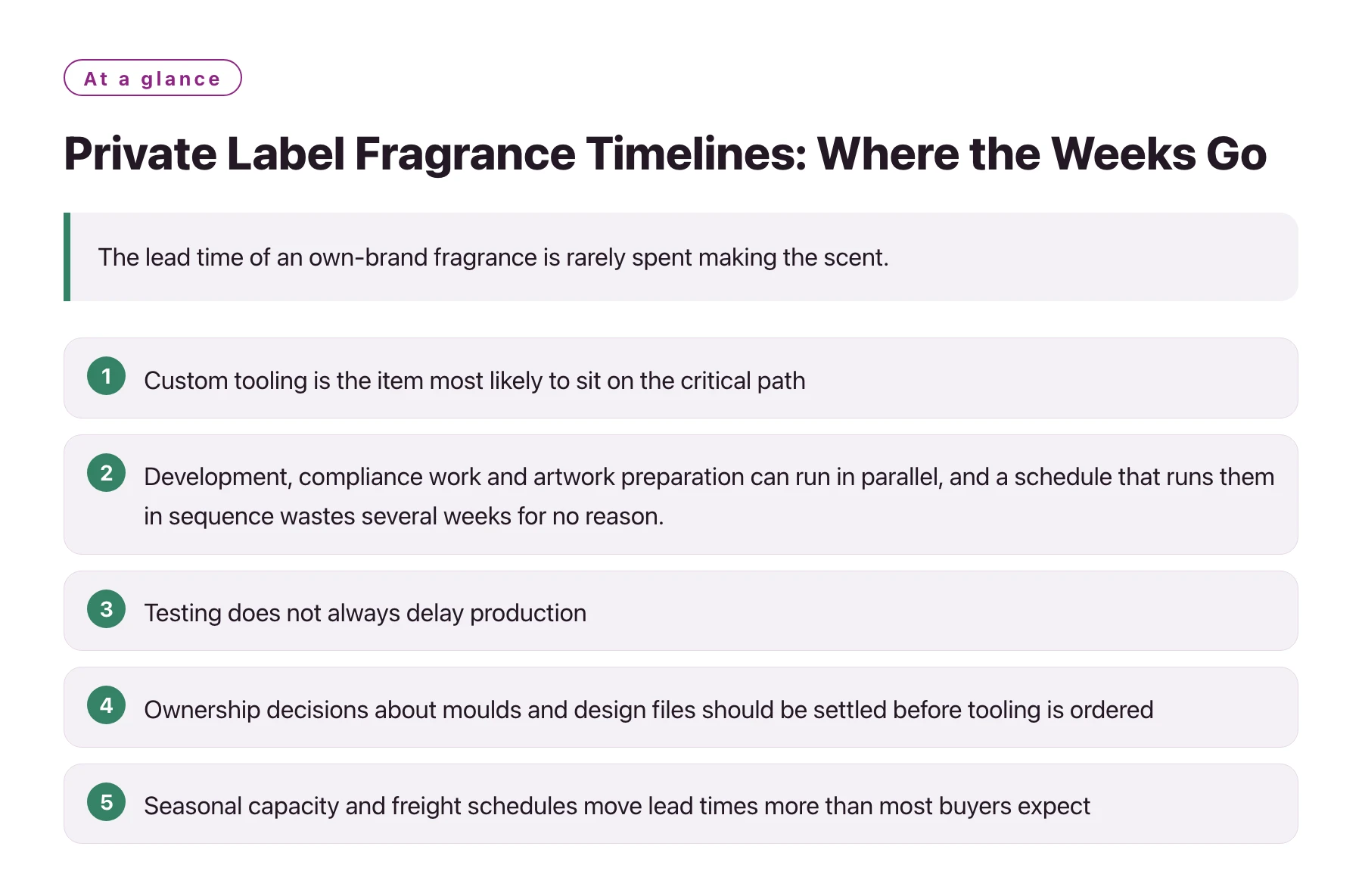
Key takeawaysCustom tooling is the item most likely to sit on the critical path, because a mould has to be made, trialled and approved before any decoration can be finalised. · Development, compliance work and artwork preparation can run in parallel, and a schedule that runs them in sequence wastes several weeks for no reason. · Testing does not always delay production, but it can gate shipping: stability and microbiological results arrive on their own timetable [1]. · Ownership decisions about moulds and design files should be settled before tooling is ordered, because a dispute at that point stops the clock [2]. · Seasonal capacity and freight schedules move lead times more than most buyers expect, so peak periods belong in the plan from the start.
Retailers usually build a launch plan around a date that marketing has already announced internally. The manufacturing sequence then gets compressed into whatever time is left, and the compression lands on whichever step has the least slack.
A more reliable approach is to identify the longest pole first. In fragrance projects that is usually a custom component, occasionally a compliance document, and only rarely the scent itself. Once the long pole is known, everything else can be arranged around it.
The phases below are planning assumptions rather than promises; every factory and every component behaves differently. The sequence, however, is consistent enough to plan against.
The phases, and what each one waits on
| Phase | Typical planning range | What gates it |
|---|---|---|
| Brief and direction selection | Days | A written brief and a decision on library-led or developed |
| Sample development and iteration | Two to four weeks | Feedback quality; each extra round adds time |
| Compliance and label content | One to three weeks | Market requirements and formula data |
| Artwork and print proofing | One to two weeks | Approved label content and pack specification |
| Custom tooling | Four to eight weeks | Mould production, trial shot and approval |
| Component procurement | Two to four weeks | Stock availability and decoration slots |
| Bulk production and filling | One to two weeks | Component arrival and line scheduling |
| Testing and release | Two to four weeks | Laboratory schedule and result review [1] |
| Freight | Two to six weeks | Mode, route and consolidation |
Read the ranges as a planning frame, not a quotation. The useful question for a supplier is which of these items they control directly and which depend on a third party, because only the first group can be accelerated by asking. Choosing a private label partner for perfume lines early also helps, because the partner's own scheduling constraints belong in the plan from the start.
Run the three parallel tracks
Scent, compliance and packaging do not have to take turns. Development can start while the label content is being checked, and artwork can be prepared while the tooling is being cut. A project that runs these as one sequence commonly takes a third longer than the same project run as three tracks.
The reason teams sequence them anyway is that each track has a different owner. Development sits with the supplier, compliance with a specialist or a regulatory contact, and artwork with a designer. Parallel work only happens when one person owns the calendar and checks the three tracks weekly.
Decide the model before sampling
A library-led range skips most of the development track and can move directly to pack confirmation, which is why it is the faster route for a first range. A developed direction needs iteration, and the schedule should carry room for at least one full extra round. The steps that make up a first brand launch are set out in this overview of Xuelei's guide, which is useful for building the calendar before the first supplier meeting.
Book tooling early, decide ownership earlier
A custom bottle or cap usually has the longest single lead time in the project. The tooling order should be placed as soon as the pack concept is frozen, and the ownership terms should be settled before that order is placed, because industrial design protection is only useful to the party that holds it [2].
What actually moves the date
Three things extend a schedule more than any production issue. The first is late feedback: a sample that sits on a desk for a week costs a week. The second is a change to the pack after artwork approval, which sends both the print and the tooling back a step. The third is market compliance discovered late, which can force a new label, a new filing or a reformulation.
Two things shorten it. Stock components remove the tooling phase entirely, and a narrow first range removes decoration setup and lowers the component volume that has to be sourced. Neither reduces quality; both reduce the number of things that can go wrong.
Ask about the supplier's peak, not just its lead time
A quoted lead time is an average; the peak season is what determines whether your order is on time. Ask when the factory's busiest months fall and how much notice it needs to reserve capacity, then place the order with that calendar in view. An established exporter such as Xuelei China is a reasonable supplier to put that question to, since capacity planning is part of running export production at all.
Build the schedule from the shipment date
Work backwards from the date the goods must leave the factory, not forwards from the project kickoff. Backward planning makes the slack visible, and visible slack is what allows a project to absorb an unexpected sample round without moving the launch.
A launch date is a commitment made by the brand, not by the factory. The supplier can only state what it controls. The part of the calendar that belongs to the brand, feedback, approvals and decisions, is where most of the recoverable time sits.
Sources
- SGS: Cosmetics, Personal Care & Household Testing —— Testing, inspection and certification services for cosmetics and personal care, including microbiological, stability and safety testing aligned with cosmetics GMP.
- WIPO — World Intellectual Property Organization —— The UN agency for intellectual property; resources on industrial design and patent protection relevant to product and packaging design.
Frequently asked questions
What is the longest single item in a fragrance project?
Usually custom tooling, followed by component procurement, if the pack is bespoke. For a range built on stock components, the longest item is often sample iteration or the compliance work.
Can a launch be compressed by paying more?
Sometimes, for tooling and freight, where priority production or air freight is available. Development and testing are harder to accelerate because they depend on elapsed time and on decisions rather than on capacity.
Does testing always delay shipping?
Not always. Testing can run alongside production, but the release decision has to wait for results. If a result is out of specification, the batch cannot ship, which is why the testing slot belongs in the plan.
How much slack should a first launch carry?
Enough for one additional sample round and one artwork revision. Those two events are common enough that a schedule without room for them is a schedule waiting to slip.
When should the factory be booked?
Before the artwork is finalised if the pack is custom, because tooling and component slots are the constrained resources. Booking the line early also makes the lead time commitment more concrete.